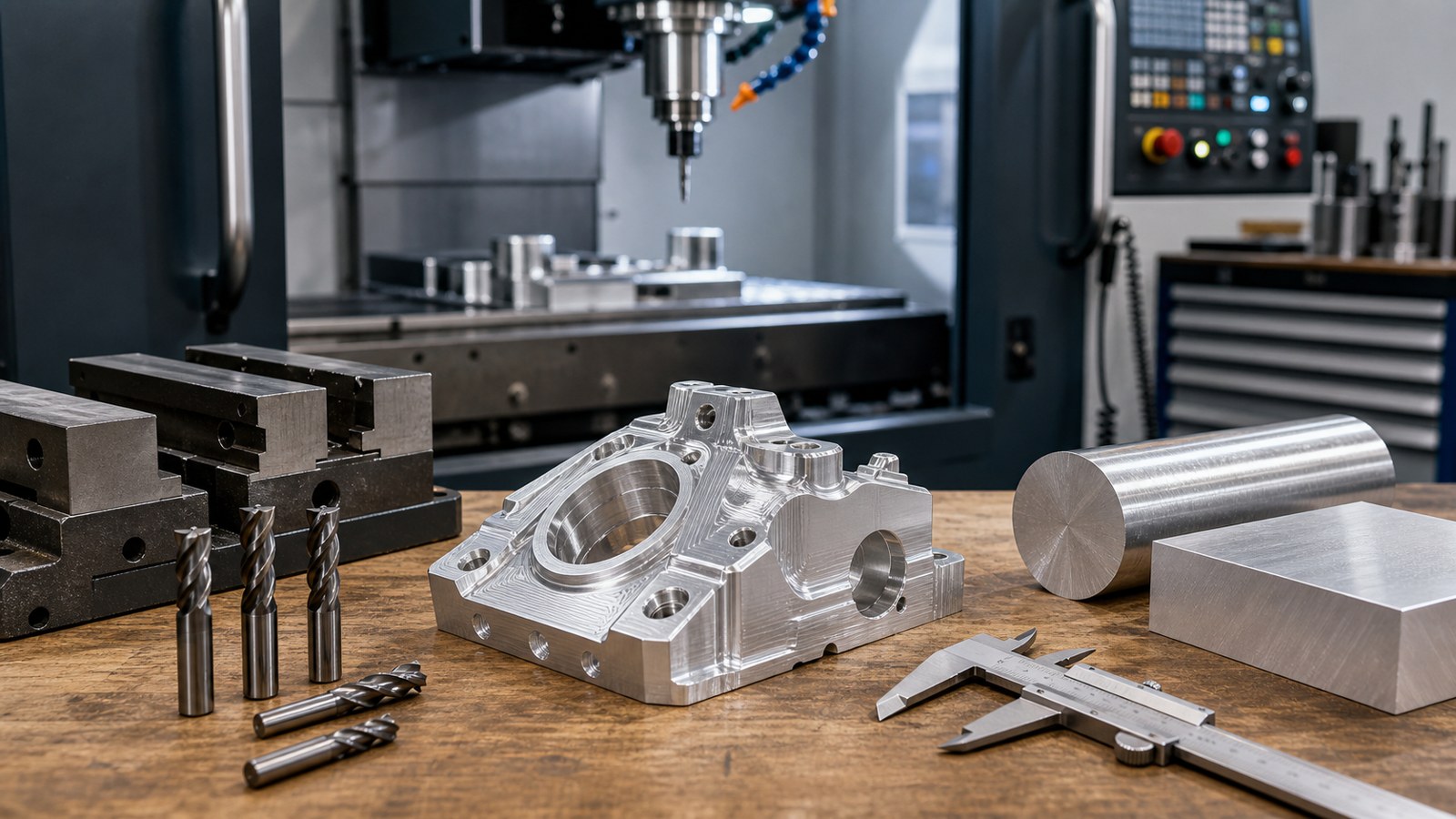
CNC machining is one of the most important manufacturing technologies in the modern world. It powers the production of everything from automotive brackets and aerospace housings to smartphone components and medical instruments. While the term may sound highly technical at first, the core idea is surprisingly straightforward. CNC machining uses computer-controlled tools to cut, shape, and finish raw material into highly accurate parts. For beginners, CNC machining is easiest to understand as a digital-to-physical process. A design begins on a computer, is translated into machine instructions, and is then carried out by a machine tool that removes material with precision. The result is a finished part that matches the intended dimensions, geometry, and surface quality. This blend of software, automation, and mechanical accuracy is what makes CNC machining such a powerful force in manufacturing.
A: Clear design intent, suitable material, controlled setup, safe workflow, and repeatable inspection.
A: It shows how the material and tool settings behave before the final part is at risk.
A: No. Tighter tolerance costs more and only helps when the function requires it.
A: Tool wear, speed, feed, abrasive choice, heat, vibration, or weak support can all contribute.
A: Heat, internal stress, uneven removal, poor clamping, or forming pressure can move material.
A: Use templates, mark clearly, cut oversize when appropriate, and inspect before each irreversible step.
A: Prototypes test ideas, while production work controls repeatability.
A: Surface prep, cleaning, masking, curing, and inspection often require more time than the main cut.
A: Ventilation and dust control are often overlooked until a process creates fumes or fine particles.
A: Confirm fit, function, finish, documentation, and any maintenance needs.
What CNC Machining Means
CNC stands for Computer Numerical Control. In traditional machining, a machinist manually operates the machine, controlling the movement of the cutting tool by hand. In CNC machining, that movement is directed by a programmed set of instructions. The computer tells the machine where to move, how fast to move, how deep to cut, and when to switch tools.
That shift from manual control to digital control changed manufacturing forever. It made production more repeatable, more scalable, and far more precise. Instead of relying entirely on hand skill for each cut, manufacturers can now produce identical parts over and over with exceptional consistency. That is why CNC machining is used for both one-off prototypes and large production runs.
Where the Process Begins
Every CNC machining job starts with an idea that needs to become a real object. That idea may come from an engineer designing a bracket, a product developer refining a prototype, or a manufacturer producing replacement parts. Before any machine starts cutting, the shape of the part has to be defined clearly. This definition usually begins in CAD software, which stands for Computer-Aided Design. CAD allows a designer to build a part digitally, setting dimensions, hole locations, wall thicknesses, curves, and tolerances. At this stage, the part is still just a digital model, but it already contains the information needed to guide the next stages of the process. For beginners, this is a key point: CNC machining does not begin at the machine. It begins with the design.
From CAD to CAM
Once the part is designed, the digital model moves into CAM software, or Computer-Aided Manufacturing. If CAD defines what the part should look like, CAM defines how the machine will make it. This is where cutting paths are created, tool choices are made, and machining strategies are planned.
The CAM system determines the sequence of operations needed to transform raw stock into the finished part. It selects paths for roughing, finishing, drilling, contouring, or facing, depending on the geometry. It also factors in material type, tool diameter, spindle speed, and feed rate. All of that information is eventually converted into machine-readable code, usually G-code, which becomes the language the CNC machine understands.
What G-Code Does
G-code is the instruction language that drives most CNC machines. It tells the machine exactly what to do during each stage of the operation. A line of G-code may command the tool to move to a specific coordinate, begin cutting at a certain feed rate, or switch to a new tool for the next step. For someone new to CNC machining, G-code is best understood as the bridge between the digital plan and the physical action. The machine does not “see” the part the way a human does. It follows commands. Every movement, every speed change, and every cut is directed by programmed instructions. This is what allows the machine to deliver precise, repeatable results at high speed.
Preparing the Machine
Before machining begins, the machine must be prepared correctly. This setup stage is one of the most important parts of the entire workflow. Even the best design and most polished code can fail if the machine is not set up properly.
The raw material, often called stock or a workpiece, must be secured firmly in place. This is done with a vise, clamps, fixtures, or other workholding devices. The cutting tools must be loaded into the machine, and their exact positions must be measured. The machine also needs to know where the workpiece begins, which is established through a reference point or zero point. This setup work ensures that the machine starts cutting in the correct location and follows the program accurately.
Understanding the Cutting Tools
CNC machining depends on cutting tools to remove material. These tools come in many forms depending on the job. End mills are common in milling operations, drill bits create holes, face mills flatten surfaces, and lathe inserts shape rotating parts. Each tool has a specific purpose and geometry. The choice of tool affects more than just shape. It also influences speed, finish quality, heat generation, and tool life. A larger tool may remove material faster, while a smaller tool may be needed for tight corners or fine details. Beginners often think the machine alone creates the part, but the tool is just as important. The machine provides movement and control, while the tool does the physical cutting.
How Material Is Removed
At the heart of CNC machining is subtractive manufacturing. This means the process starts with a block, bar, plate, or cylinder of raw material and removes unwanted material until the final shape remains. This is the opposite of additive manufacturing, such as 3D printing, which builds parts layer by layer.
Material removal happens through a controlled cutting action. In milling, the tool rotates while the workpiece stays fixed or moves in relation to it. In turning, the workpiece rotates while the cutting tool is fed into it. The speed of the tool, the rate of movement, and the depth of each cut all affect the final result. Precision comes from controlling these factors closely and repeating them consistently.
The Main CNC Machining Operations
Several core machining operations appear again and again in CNC work. Milling is used to cut flat surfaces, pockets, slots, contours, and complex shapes. Turning is used for round parts such as shafts, bushings, and threaded components. Drilling creates holes, boring enlarges them accurately, and tapping adds threads. A single finished part may require several of these operations in sequence. A block might be milled to shape, drilled for mounting holes, and then finished with a fine pass for smoother surfaces. More advanced machines can combine multiple operations in one setup, which saves time and improves consistency. That ability to integrate tasks is one reason CNC machining is so efficient in modern production.
Why Precision Matters So Much
One of the defining features of CNC machining is precision. Many parts must fit into assemblies with little room for error. If a hole is slightly off position or a surface is slightly oversized, the entire assembly may fail or perform poorly. That is why CNC machining is trusted for industries where tolerances matter deeply.
Precision in machining comes from a combination of machine rigidity, accurate programming, stable tooling, and careful setup. Temperature, vibration, tool wear, and material behavior can all influence the final outcome. This is why machining is both a science and a craft. The software and machine may do the cutting, but achieving consistent precision still depends on smart decisions and attention to detail.
The Role of Coolant and Chip Control
As cutting occurs, heat and friction build quickly. Without control, that heat can damage tools, distort the part, or reduce surface quality. Coolant helps manage this by cooling the cutting zone and lubricating the contact between tool and material. Chip control is equally important. As material is removed, chips must clear the cutting area efficiently. If chips pile up, they can scratch the part, interfere with the toolpath, or cause excessive heat. Good CNC machining is not just about cutting. It is also about managing everything that happens around the cut so the machine can keep working smoothly and accurately.
Inspection and Quality Control
Once the machining is complete, the part is not simply assumed to be correct. It must be checked. Inspection and quality control are essential parts of the CNC process, especially when parts must meet exact dimensions or perform in critical systems.
Inspection may involve calipers, micrometers, dial indicators, height gauges, or coordinate measuring machines. These tools verify that holes are in the right place, surfaces are flat enough, and dimensions fall within tolerance. For beginners, this step is important because it shows that CNC machining is not only about making parts quickly. It is about making parts correctly, every time.
Common Materials Used in CNC Machining
CNC machines can work with a wide range of materials. Aluminum is popular because it is lightweight, easy to machine, and widely used in many industries. Steel offers strength and durability but can be harder on tools. Stainless steel resists corrosion, titanium offers high strength with low weight, and brass provides good machinability and attractive finish properties.Plastics are also common in CNC machining. Materials such as ABS, acrylic, nylon, Delrin, and polycarbonate are often used for lightweight or non-conductive parts. The choice of material changes the entire strategy of the job. Tool selection, cutting speed, coolant use, and finishing passes all depend on how the material behaves under the cutter.
How a Part Moves from Rough to Finished
Most CNC machining jobs happen in stages. Early cuts are often roughing passes, which remove large amounts of material quickly. These passes focus on efficiency rather than final appearance. Once most of the excess material is gone, the process moves to finishing passes.
Finishing cuts are lighter, slower, and more refined. They bring the part to final size and improve surface quality. In many cases, the difference between a rough-cut part and a finished one is dramatic. The roughing stage creates the general form, while the finishing stage creates the precision and polish that make the part usable.
How Automation Improves Production
CNC machining is powerful not only because it is accurate, but also because it is efficient. Once the setup and program are proven, the same job can be repeated many times with minimal variation. This makes CNC machining ideal for batch production and scalable manufacturing. Automation reduces manual effort and shortens cycle times. Tool changers switch cutters automatically, probes verify positions, and advanced systems monitor performance in real time. Some shops even run lights-out machining, where machines continue producing parts with minimal human presence. For beginners, this is one of the most exciting aspects of CNC technology. It combines mechanical cutting with digital efficiency in a way that dramatically expands what manufacturing can do.
Industries That Depend on CNC Machining
CNC machining supports a wide range of industries because so many products depend on accurate, durable components. Aerospace companies use it for lightweight yet precise structural parts. Automotive manufacturers rely on it for engine components, mounts, housings, and prototypes. Medical companies use CNC machining for implants, surgical tools, and specialized equipment.
It is also common in robotics, consumer electronics, energy systems, defense manufacturing, and industrial equipment. Even custom motorcycles, hobby projects, and small business products can begin with CNC-machined components. Its reach is broad because the need for precise parts exists almost everywhere.
Challenges Beginners Should Understand
While CNC machining offers major benefits, it is not effortless. Setup takes time, tools wear down, programs need verification, and poor workholding can ruin a part quickly. Small mistakes in code or measurement can lead to scrap, broken tools, or machine crashes. For beginners, that is not a reason to be intimidated. It is a reason to respect the process. CNC machining rewards careful planning and disciplined execution. The more each stage is understood, from design to setup to inspection, the better the final results will be. Learning the workflow is just as important as learning the machine itself.
Why CNC Machining Remains So Important
Even as new manufacturing technologies evolve, CNC machining continues to hold a central role in production. It offers a combination of precision, material flexibility, surface quality, and reliability that few other processes can match. It is often the best solution for functional prototypes, end-use parts, and components that require exact tolerances.
It also works well alongside other methods. A product may begin as a 3D-printed concept, move into CNC-machined prototypes, and later transition into molded production. In that larger manufacturing ecosystem, CNC machining remains one of the most trusted and widely used technologies because it consistently turns digital designs into real, dependable parts.
Final Thoughts
CNC machining is the process of using computer-controlled machine tools to turn raw material into finished parts with precision and repeatability. From the first CAD model to the final inspection, every stage builds on the last. Design defines the part, CAM creates the strategy, G-code drives the machine, setup prepares the environment, tools remove the material, and inspection confirms the result. For beginners, the most important takeaway is that CNC machining is not one single action. It is a complete workflow. It starts with an idea and ends with a part that can be measured, assembled, and used in the real world. That journey from start to finish is what makes CNC machining so fascinating, so practical, and so essential to modern manufacturing.