The Best Laser-Cutting Material Depends on the Part You Need
A beautiful cut starts before the laser turns on. Two sheets that look almost identical can respond very differently to the same beam: one leaves a crisp edge, another develops residue, and a third belongs nowhere near that machine. Choosing the best material for laser cutting means connecting four decisions: what the stock actually contains, whether the available laser can process it, what the finished edge should look like, and how the part must perform afterward. Wood, acrylic, metal, and paper all offer useful possibilities, but each rewards a different kind of design judgment. A display face, a folded package, and a working bracket need different properties even when their outlines look equally simple. Start with the job the material must do, then work backward to the sheet specification and cutting process.
A: No. Compatibility depends on wavelength and equipment; confirm clear PMMA cutting capability for the specific machine.
A: No. Core quality, adhesives, thickness consistency, and product approval can differ substantially.
A: Do not assume it will. Verify cutting capability for the exact alloy, thickness, and part geometry.
A: Tight hardware, local stress, and insufficient clearance can still damage the acrylic around the connection.
A: No. Obtain reliable product identification and supplier documentation rather than experimenting with an unknown sheet.
A: Only partly. Check folding, tab retention, handling, and assembly as well as the cut outline.
A: Material thickness variation and cutting-process variation can change the effective clearance.
A: Evaluate scrap, cutting reliability, cleaning, finishing, and assembly before comparing finished-part cost.
A: Consider alternatives when composition, thermal effects, thickness, or service requirements make laser cutting unsuitable.
A: Provide the approved product specification, representative sample, drawing revision, and agreed finish expectations.
Match the Material to the Laser Before Comparing Prices
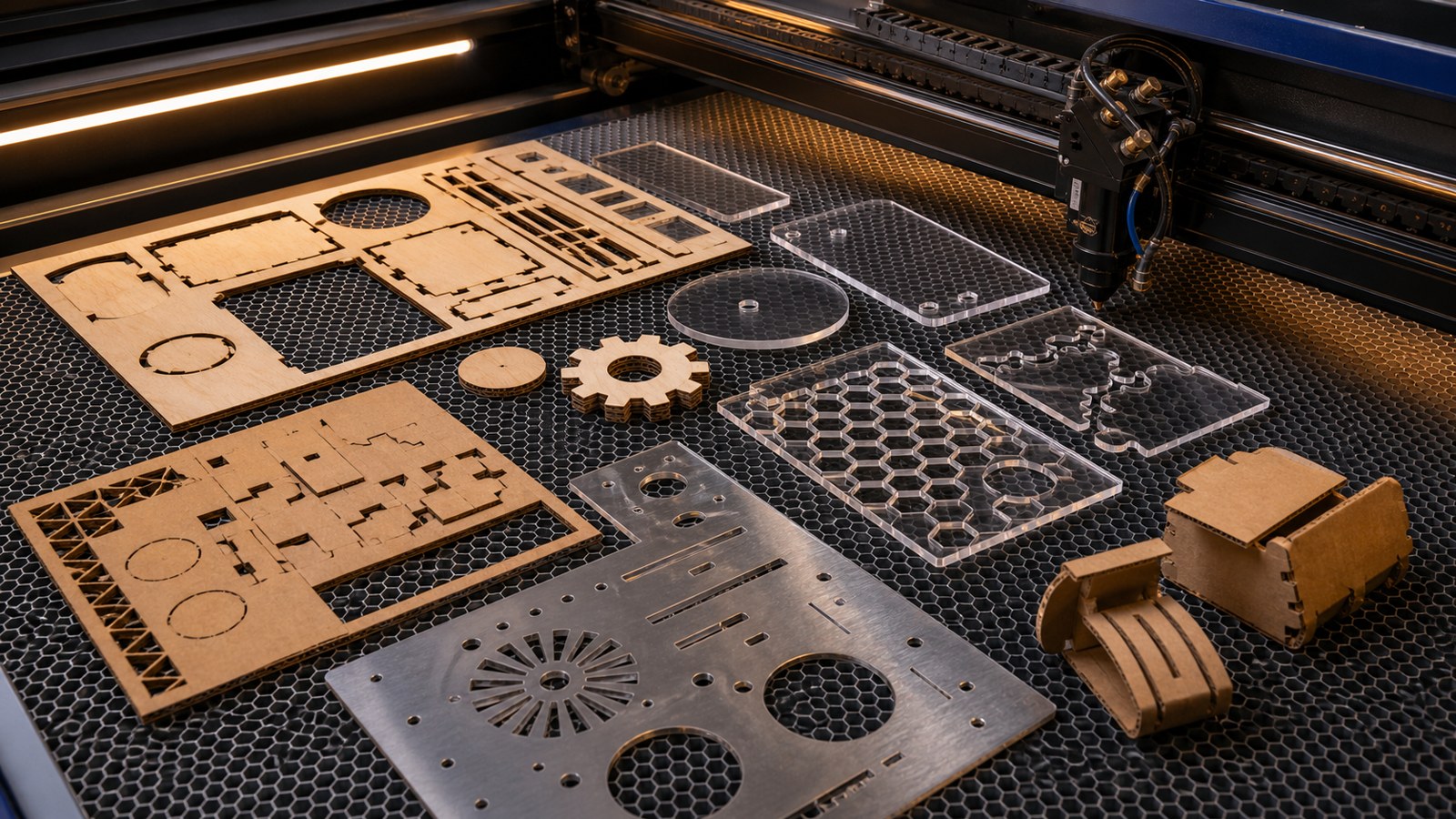
Laser cutting is a family of processes rather than one universal capability. CO2 systems commonly serve wood, acrylic, paper, and other approved nonmetal stock, while industrial fiber cutting systems are widely used for sheet metal. A small fiber marking machine and a production metal-cutting machine are very different tools despite sharing a source category. The machine’s documented material range, available power, optics, work area, and extraction requirements establish the starting boundary.
Cutting and marking also need separate checks. A machine may mark a coating or engrave a surface without cutting through the underlying sheet. Transparent materials introduce another distinction because visible-light diode machines do not interact with clear acrylic in the same way as CO2 equipment. Confirm the exact material, thickness, and intended operation with the machine supplier or fabrication shop rather than treating a general compatibility chart as a cutting guarantee.
Wood Brings Warmth, Grain, and Useful Structural Options
Plywood is a practical choice for models, enclosures, decorative panels, and interlocking assemblies because its layered construction offers useful stiffness in thin sheets. Quality varies substantially, however. Internal voids, inconsistent adhesives, patches, and variable thickness can interrupt a cut or weaken a narrow feature. Stock sold specifically for laser processing reduces uncertainty, but a receiving check and a small trial remain worthwhile when the project depends on consistent fit.
Solid wood gives visible grain and a natural finish that many display and craft projects need. Grain direction becomes part of the design, especially around thin bridges, narrow letters, and projecting tabs. A detail that survives along the grain may snap more easily across it. Natural variation also changes the appearance of cut edges and engraved areas, so a sample from the actual board is more informative than a photograph of another species.
MDF offers a comparatively uniform surface and suits painted components or prototypes where exposed grain is unnecessary. Its binders and composition still require product-specific approval, effective extraction, and a finishing plan. All these wood products can leave dark edges or residue. Decide whether that edge is an intentional visual feature, something to seal, or labor that the project budget must absorb before selecting the cheapest sheet.
Acrylic Excels When the Edge Is Part of the Design
Acrylic, also called PMMA, is often attractive for display panels, light-related components, decorative profiles, and transparent covers. On a suitable CO2 system, a well-developed process can produce a clear, glossy edge that becomes part of the finished appearance. That appeal does not remove the need to check flatness, thickness, masking compatibility, and the size of delicate details. Treat acrylic as a material with its own mechanical limits rather than a transparent substitute for metal.
Cast and extruded acrylic can behave differently during engraving, cutting, and fitting, so ask which manufacturing type the supplier is providing. Evaluate the actual sample against the desired engraving contrast, edge appearance, and dimensional fit. Acrylic can crack around poorly designed fastener holes or highly stressed corners. Leave assembly clearance, avoid forcing tight joints, and consider whether the finished part needs a tougher material and a different fabrication process instead.
Metal Requires a Metal-Cutting Capability
Mild steel, stainless steel, and aluminum can all be excellent laser-cutting materials when processed on equipment designed for them. They serve different needs in brackets, panels, screens, and enclosures: stiffness, corrosion resistance, appearance, weight, and later joining influence the choice. Specify the alloy or grade and sheet thickness rather than ordering simply by color or by the word metal. The downstream coating or welding operation may depend on that specification.
The quote should identify the expected cut condition and any secondary work. Dross, burrs, oxide condition, protective films, and cosmetic-face requirements affect whether a part is ready for assembly or still needs finishing. Small holes and narrow webs also deserve review against thickness and the shop’s demonstrated capability. A clean sample edge does not prove that every feature in a dense drawing will cut equally well.
Do not assume a desktop engraver will cut sheet metal because its marketing mentions metal processing. Marking anodized aluminum, bonding a marking compound, and cutting a structural bracket are separate tasks. For a mixed-material project, outsourcing the metal components while producing approved nonmetal parts in-house may be the most practical arrangement. Compare complete parts, including deburring and delivery, when deciding whether that split makes economic sense.
Paper and Cardboard Turn Flat Stock into Lightweight Forms
Paper, cardstock, and corrugated board are useful for packaging prototypes, architectural studies, stencils, invitations, and folded structures. Their low mass makes them responsive to cutting, but it also makes scorching and small-feature damage visually obvious. Coatings, adhesive layers, flute direction, and sheet flatness can change the result. Design the cutting and folding sequence together so delicate areas remain supported until they can be handled. A successful prototype should prove fold behavior, tab retention, and assembly order as well as the accuracy of the outline; a beautiful flat pattern is only the beginning of a usable package or model.
Specialty Sheets Need a Verified Identity
Leather, textiles, cork, rubber, and selected engineering plastics can extend the range of a laser shop, but a broad material family is too vague for approval. Leather finishes and tanning chemistry differ, synthetic fabrics may melt, and rubber compounds contain different additives. Purchase a traceable product intended for the proposed laser operation and review the supplier’s documentation. Appearance alone cannot establish what a sheet contains.
Unknown plastic is a poor candidate for trial-and-error cutting. PVC and vinyl products are unsuitable for laser processing, and other polymers or treated composites may create hazardous emissions or damage equipment. The right response to uncertainty is identification and approval, not a more powerful extraction fan. Some useful materials belong on a router, knife cutter, waterjet, or another process even when their shape would be easy to draw for a laser.
Specify Thickness, Fit, and Surface Quality Together
Nominal thickness is only one part of a reliable material specification. Sheet variation can determine whether a slot joint assembles smoothly or requires force, and the cutting kerf removes material from the drawn path. Measure representative stock and make a fit sample using the intended process. For repeated assemblies, ask how the supplier controls thickness and whether the next delivery will come from the same product line.
Surface expectations deserve equal attention. A protective film may preserve a cosmetic face, but it must be approved for processing and may need removal before later operations. Wood can require sanding or sealing, paper can show handling marks, and metal may need deburring before coating. Define which face is visible, which edges are touched, and which dimensions are functional so the fabrication shop can direct effort where it matters.
Then consider the environment after fabrication. Outdoor exposure, humidity, cleaners, heat, impact, and repeated assembly can eliminate an otherwise attractive option. A thin indoor display panel and a load-bearing machine component should not share a material decision simply because both can be cut. Where performance is consequential, use suitable engineering review and representative testing rather than inferring service suitability from edge quality.
Compare Finished-Part Cost Instead of Sheet Cost
The lowest sheet price can produce the most expensive finished part when it adds rejected cuts, cleaning, finishing, or assembly time. Better plywood may reduce interrupted cuts, and a more suitable plastic may eliminate a polishing step, but those benefits depend on the actual job. Ask for quotations against the same drawing, material specification, quantity, and finish expectations so the alternatives are genuinely comparable.
Material utilization also changes the economics. Grain direction, cosmetic-face orientation, sheet dimensions, and the spacing needed around delicate features can restrict nesting. Keep spare material for trials and replacement pieces rather than assuming every square inch becomes a sellable component. A small pilot run often reveals the real cost drivers more clearly than a large order based on theoretical cutting time.
Use a Material Trial to Answer Specific Decisions
A useful trial is a miniature version of the demanding features in the real part. Include the smallest intended hole, a narrow bridge, a representative inside corner, and a joint if the design uses one. Inspect both faces and the full edge, then assemble and handle the result as the finished product will be handled. For a display, examine it under the expected lighting; for a package, fold and unfold it; for an enclosure, check the fastener interfaces. Record the stock identity and thickness alongside the observations so a passing result can be reproduced. Do not treat one clean outline as proof that the material is ready for production.
Review Substitutions Before They Reach the Cutting Bed
A replacement sheet can look convincing while changing the result that the first sample established. A different plywood core may affect tiny bridges, another acrylic product may alter engraving appearance, and a coated paper can behave differently when folded. Make material substitutions visible to the person responsible for approving the part. Purchasing convenience should trigger a short review rather than silently changing the production specification.
Separate acceptable variation from features that must remain consistent. Natural wood grain may vary within an agreed range, while a mating slot still needs dependable fit. A hidden face may tolerate a cosmetic difference that the front of a display cannot. Writing these distinctions into the order helps a supplier propose workable alternatives instead of guessing which properties the designer values most.
When a change affects composition, thickness, or processing approval, repeat the relevant part of the trial before continuing. Reuse the same demanding geometry and compare the new sample with the retained reference. Document the outcome alongside the revised stock designation. This keeps a practical purchasing decision from becoming an unexplained change in assembly behavior or finished appearance.
A Practical Shortlist for the Next Project
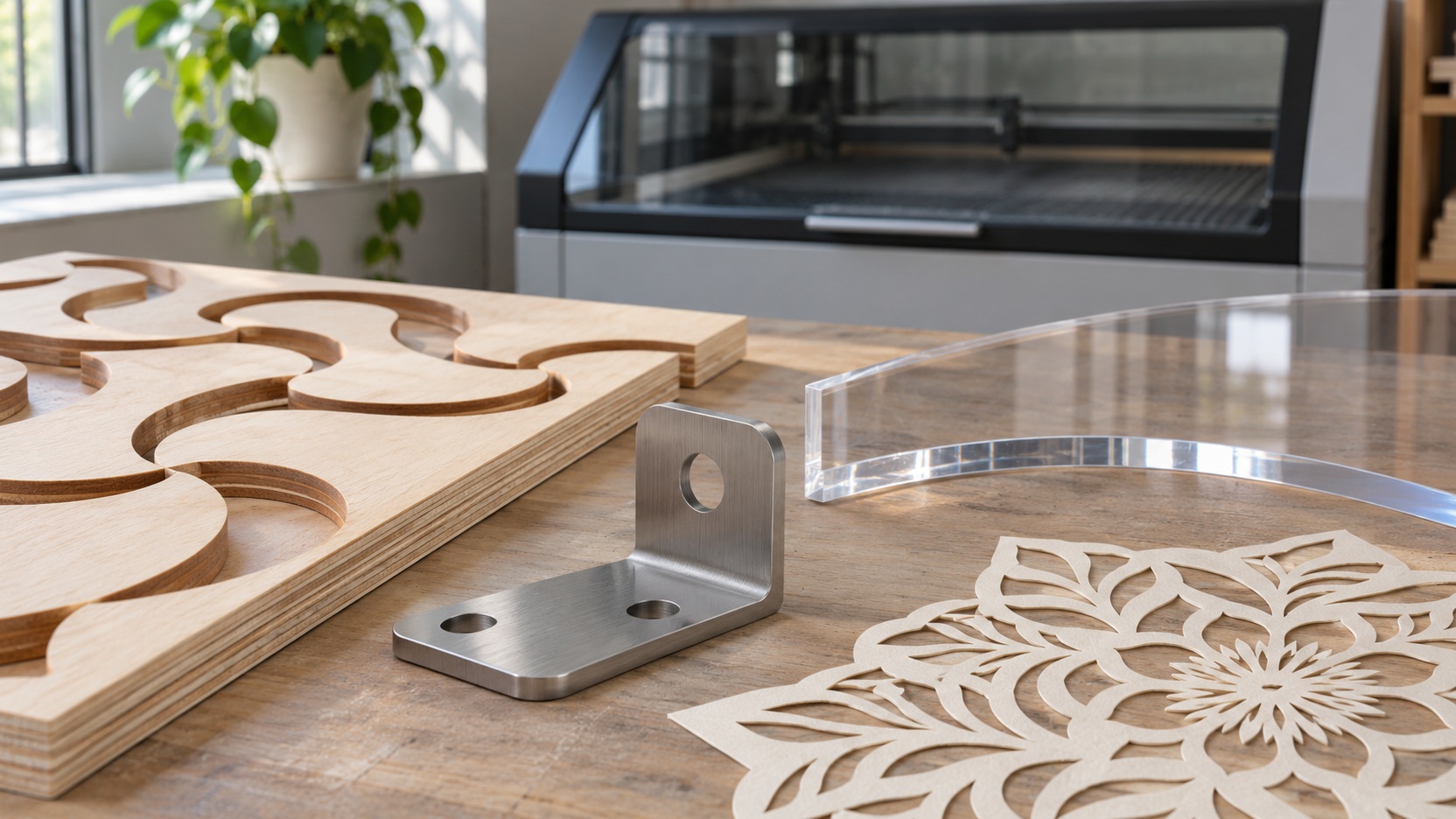
For a warm-looking model or interlocking structure, begin by evaluating consistent laser-suitable plywood. For a transparent or glossy display component, investigate the appropriate acrylic product on a compatible CO2 system. For a working bracket or durable metal panel, bring a specified metal grade to a shop with the necessary cutting capability. For folded mockups and lightweight presentation pieces, test a documented paper or board stock that behaves well during both cutting and assembly.
The final choice should survive a sequence of concrete checks: verified composition, confirmed machine compatibility, acceptable edge and surface quality, reliable fit, and suitability for the finished use. Keep the approved sample and material specification together when placing the production order. That gives both the designer and fabricator a shared target and makes substitutions easier to evaluate. The best material is the one that produces a dependable finished part with a process the shop can repeat.